|
Living
on the Vine
Reflections by Dr. Scott Hahn
|
 |
 |
In today's Gospel, Jesus returns to the Old Testament symbol of
the vineyard to teach about Israel, the Church, and the kingdom
of God.
And the symbolism of today's First Reading and Psalm is readily
understood.
God is the owner and the house of Israel is the vineyard. A cherished
vine, Israel was plucked from Egypt and transplanted in a fertile
land specially spaded and prepared by God, hedged about by the
city walls of Jerusalem, watched over by the towering Temple.
But the vineyard produced no good grapes for the wine, a symbol
for the holy lives God wanted for His people. So, God allowed
His vineyard to be overrun by foreign invaders, as Isaiah foresees
in the First Reading.
Jesus picks up the story where Isaiah leaves off, even using Isaiah's
words to describe the vineyard's wine press, hedge, and watchtower.
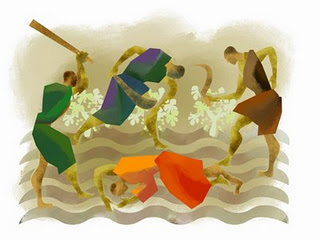
Israel's religious leaders, the tenants in His parable, have learned
nothing from Isaiah or Israel's past. Instead of producing good
fruits, they've killed the owner's servants, the prophets sent
to gather the harvest of faithful souls.
In a dark foreshadowing of His own crucifixion outside Jerusalem,
Jesus says the tenants' final outrage will be to seize the owner's
son and to kill him outside the vineyard walls.
For this, the vineyard, which Jesus calls the kingdom of God,
will be taken away and given to new tenants—the leaders of
the Church, who will produce its fruit.
We are each a vine in the Lord's vineyard, grafted onto the true
vine of Christ (see John 15:1-8), called to bear fruits of the
righteousness in Him (see Philippians 1:11) and to be the "first
fruits" of a new creation (see James 1:18).
We need to take care that we don't let ourselves be overgrown
with the thorns and briars of worldly anxiety. As today's Epistle
advises, we need to fill our hearts and minds with noble intentions
and virtuous deeds, rejoicing always that the Lord is near.
|